A Brief History of Bagpipe Bands in North Carolina
Part 1

A Brief History of Bagpipe Bands in North Carolina

by Emily Sprague

There are mentions of Scottish pipers in North Carolina in the 18th and 19th centuries, including the piper and drummer who signaled the beginning of the historic battle at Moore’s Creek bridge in 1775. However, the first bagpipe band only appeared in the state mid-way through the 20th century. Following is the first of three articles tracing the lineage of North Carolina’s 44 known bagpipe bands.

The First Thirty Years

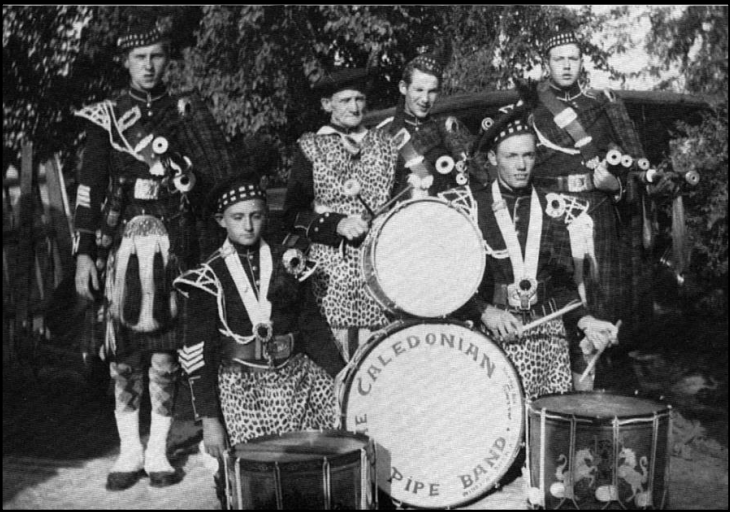
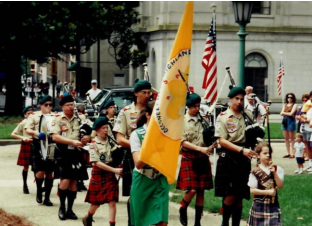
The first bagpipe band in North Carolina was formed in 1946 by Jack Smith, a Scottish emigrant living in the Winston-Salem area. The Caledonian Pipe Band consisted of P/M Smith, his two high school age sons and six other young people, all taught to pipe or drum by Smith. The band only lasted a few years with the most memorable performance being Kerr Scott’s gubernatorial parade in Raleigh. With around twenty active bands today, it is hard to imagine that there were no pipe bands in NC in 1956 when Agnes McRae Morton and Donald McDonald first organized the Grandfather Mountain Highland Games.
Jack Smith's Caledonian Pipe Band, ca. 1946
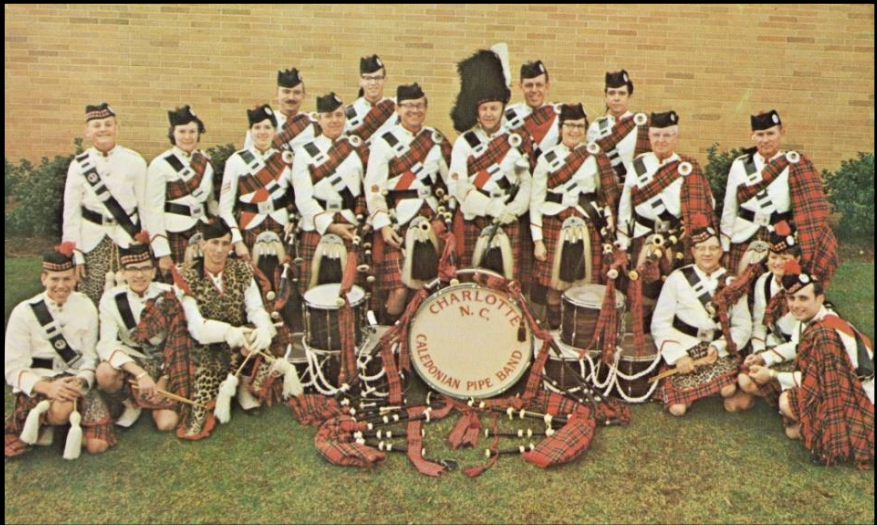
Charlotte Caledonian Pipe Band, 1968

The second band in the state was also formed by Jack Smith. In 1964, the president of the Burns Society of Charlotte sought Smith’s help in starting a pipe band in Charlotte, the Charlotte Caledonian Pipe Band. Within a few years, Harvey Ritch moved into the role of Pipe Major, launching his influence on the local piping scene for several generations.

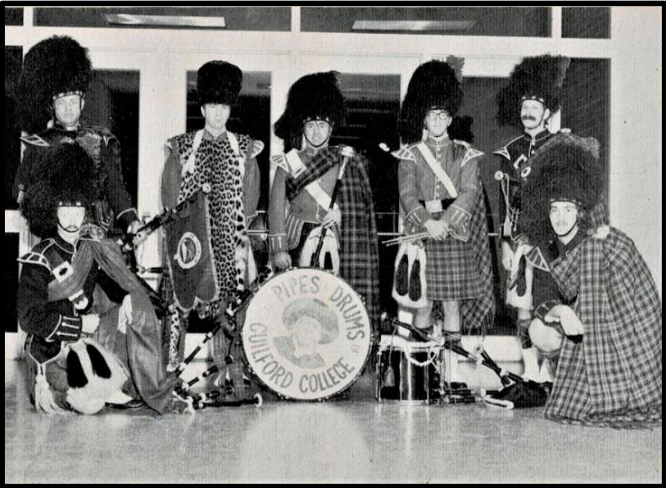
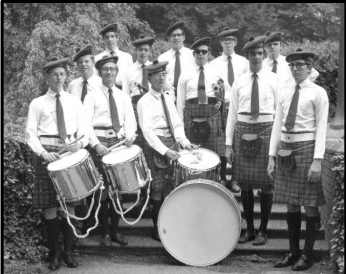
While Charlotte was forming a band, piping was also heard in Greensboro as Dr. Henry Hood, a professor at Guilford College, started the Guilford College Pipe Band made up of students and faculty. In 1968, Ted Tonkinson and Bob Howland, two graduate students at North Carolina State University in Raleigh formed the second college and university pipe band in the state, the NCSU Pipes and Drums. For the first 10 years, its band membership was restricted to current students.
Guilford College Pipes and Drums, 1970
NCSU Pipes and Drums, 1970

Piping Schools Are Established

Interest in piping accelerated through the late 1960’s and 1970’s. In the span of thirteen years, three different summer schools for piping and drumming were established. Sally Southerland realized her dream of teaching Scottish culture to young people through the Highland Arts Camp (1966-1982), later known as the School of Scottish Arts, held on the campus of Lees McRae College. John MacFadyen and Sandy Jones started the Grandfather Mountain Highland Games School of Piping in 1972 at Crossnore School. The school later became the North American Academy of Piping and Drumming and moved to Valle Crucis. Albert McMullin established the Balmoral School of Piping (1979-1991) on the campus of Guilford College.
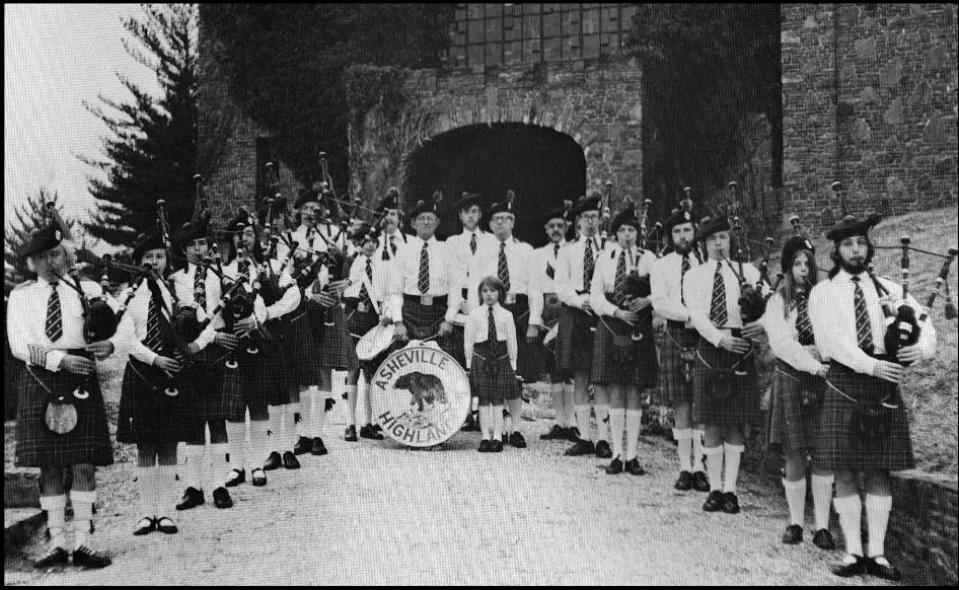
Meanwhile, Scottish emigrants John Kiely and Ken Swinton taught piping to young people in the Asheville area, the beginning of the Asheville Highlanders (1972). With sponsorship by the Montreat Scottish Society, the name changed to the Montreat Scottish Pipes and Drums in 1983. Statesville High School (1961) and Scotland County High School (1975) added pipe corps to their marching bands.
Asheville Highlanders, 1975

Band Competitions

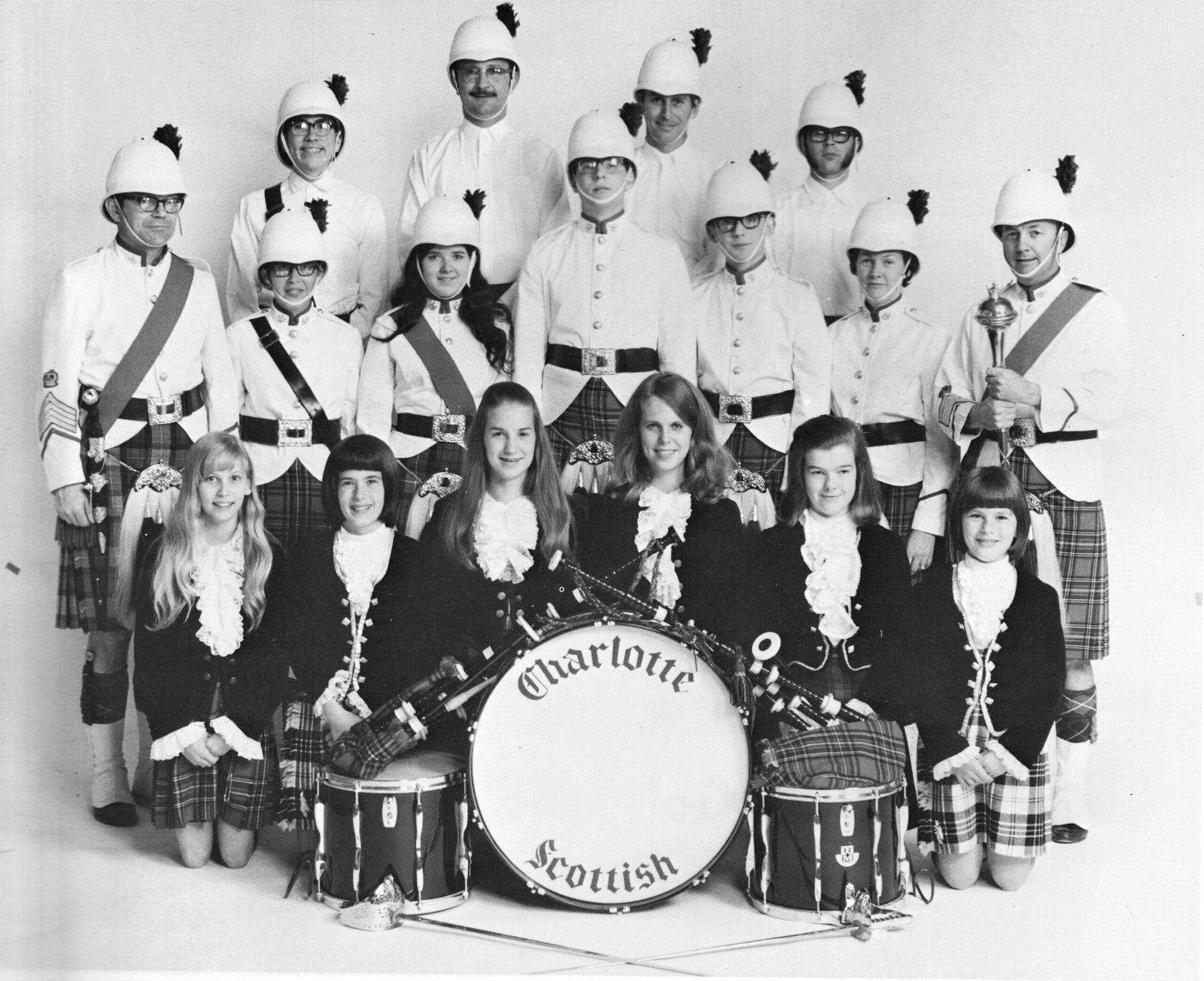
Charlotte Scottish, 1974

Harvey Ritch selected young players from the Charlotte Caledonian band to form the state’s first competition band, the Charlotte Scottish (1970). This picture includes Highland dancers. Albert McMullen was recruited to lead the band. It is remarkable that the young band won Grade 3 at its first competition in Fair Hill, MD in June 1971. In 1973, Harvey Ritch organized the Charlotte Scottish Games, a band competition featuring fourteen bands. North Carolina bands were represented in each grade: Charlotte Scottish in Grade 2; NCSU Pipes and Drums in Grade 3; Charlotte Caledonian Pipe Band in Grade 4. The Games were only held one year. In 1974, Ritch moved his Scottish import store, Everything Scottish, to Banner Elk and merged the Charlotte Scottish with the newly formed Grandfather Mountain Highlanders.

Two other Scottish gatherings in the 1970’s were the Scotch Faire at Ellerbe Springs (1976 and 1977) and the Flora Macdonald Highland Games at Red Springs (1976 to 2007). For many years, the FMHG offered a popular quartet competition for pipers before changing to full band contests.

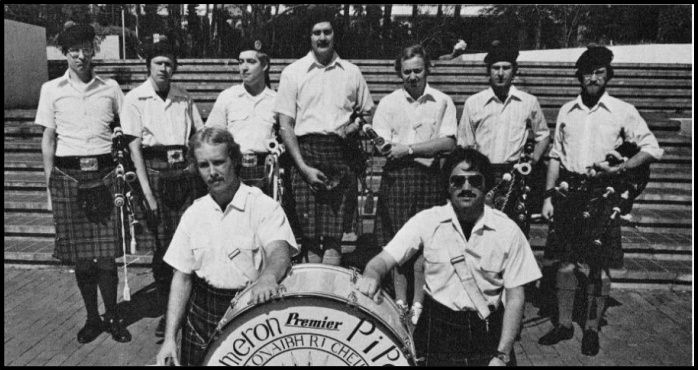
From the first pipe band in 1946 until the Charlotte Scottish competed in 1971, all North Carolina bands were performing bands only. By 1976, five bands were entering sanctioned contests: Charlotte Caledonian, NC State, Asheville Highlanders, Grandfather Mountain Highlanders, and Clan Cameron Pipe Band (1976- 1978). Clan Cameron was a band made up of pipers and drummers acquainted through piping schools, each a top solo player. Under the direction of P/M Bill Logan, Clan Cameron easily won each of the four contests they entered. Coming next: The lure of pipes extends to Shriners, Boy Scouts, and towns originally settled by Scots.
Clan Cameron Pipe Band, 1978

A Brief History of Piping in NC — Part II

A Brief History of Piping in NC – Part II

Scottish immigrant Jack Smith formed the Caledonian Pipe Band in Winston-Salem in 1946, NC’s first known pipe band. Smith later formed the Charlotte Caledonian Pipe Band in 1964. Several players from that band helped launch the Charlotte Scottish which became the foundation of the Grandfather Mountain Highlanders. Asheville pipers played in the Charlotte Caledonian band until there were enough bandsmen to form the Asheville Highlanders (now Montreat Scottish). Guilford College and NC State University formed college level bands. High schools in Laurinburg and Statesville fielded bagpipe units to perform with their marching bands. In 1977, the Clan Cameron Pipe Band came together as a competition band, made up of top players who knew each other from two piping schools in the state: the North American Academy of Piping and the Balmoral School. Part II of this brief history follows the formation of community-based pipe bands from the late 1970’s to the present.

Shriners

The Oasis Highlanders (1978) was begun by Paul Webb as a band unit of the Oasis Shrine Temple in Charlotte. The band enjoyed playing for Shrine ceremonies and parades throughout western North Carolina. A highlight was joining with Shrine pipe bands from surrounding states at the South Atlantic Shriner Association. When Bud Cates and Frank Spears heard the pipers in Myrtle Beach, they were inspired to start the Amran Highlanders (1984) in the Raleigh area. A few pipers formed the Sudan Highlanders (1983) based in New Bern and played for Shrine events across Eastern North Carolina. Shrine bands play for the pure fun of it, valuing the fellowship of being in the band. Since non-Shrine pipers could not perform in Shrine events, the McLeod Pipe Band (1985) evolved from the Amran Highlanders as an all-inclusive group.
McLeod Pipe Band
Occoneechee Highlanders

Scout Bands

Gale Buck, a piper in the McLeod Pipe Band, formed the state’s first Boy Scout band, the Occonneechee Highlanders (1990). As youth bands tend to do, players grew up and moved away. The remainder merged with the McLeod Pipe Band and the name changed to the City of Oaks Pipe Band (2000). This band merged with NCSU Pipes and Drums in 2005. Meanwhile in Wilmington, Scoutmaster Darrell Chambers and Kirk Rose started a second Scout band, the Cape Fear Highlanders (1999). As a Venturing Crew troop, it included girls. Each of these scout bands thrived for several years with dedicated leaders and supportive parents.

Scottish Heritage Across the State

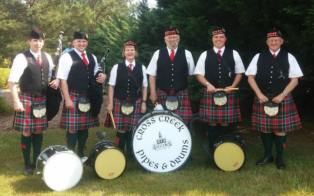
Cross Creek Pipes and Drums
Perhaps most pipe bands come together with the drive of one individual. Knowing that Fayetteville was originally settled by Scots, Bob Palmer felt strongly that the city should have a pipe band. He learned to pipe at the NAAPD, returned home and formed Cross Creek Pipes and Drums (1987). Piper Michael Waters moved to Highlands about the same time that Dr. Gordon Teal, Keeper of Her Majesties Tartans, created a Scottish Tartans Museum in Highlands. Dr. Teal envisioned a pipe band in the area to complement the museum, and

the Highlands Pipe Band was formed (1989). Another confluence of a Scottish museum and a band occurred at St. Andrews Presbyterian College. Piper Bill Caudill was recruited by his alma mater to develop a Scottish Heritage Center on campus as well as form the St. Andrews Presbyterian College Pipe Band (1991). When piper Ed Krintz and his wife Timmy Hord moved to Charlotte, they organized a band to fill the void left by the dissolution of the Charlotte Caledonian Pipe Band in 1990

Highlands Pipe Band
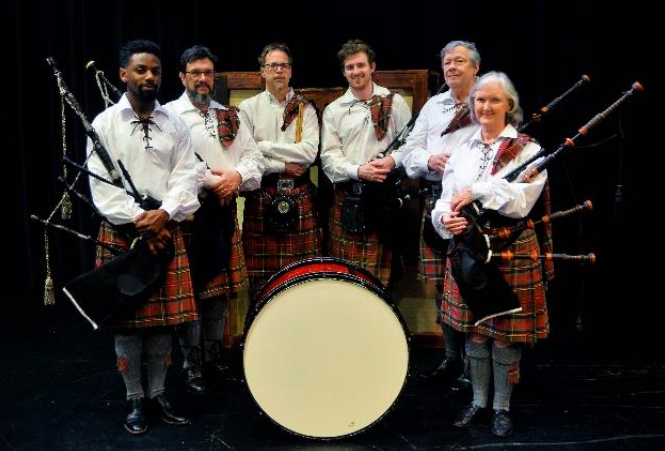
Loch Norman Pipe Band
The Loch Norman Pipe Band made its debut at the inaugural Loch Norman Highland Games in 1996, held at Historic Rural Hill near Huntersville. The same year, Andy Simpson, a former Scots Guards piper, formed the Port City Pipes and Drums in Wilmington, with the band debuting at a Wilmington Burns Supper.

Irish Heritage Too

The first Irish band in the state, Ceol Na Gael Irish Pipe Band (2001) was established in Charlotte by pipers Bruce Thompson and Michael Holian who had recently moved from out of state and met each other at the Ancient Order of Hibernian in Charlotte.

Ceol na Gael Irish Pipe Band
An Gorta Mor
The state’s second Irish band, An Gorta Mor, was started by Dennis O’Brien in Wake Forest in 2020 as a service band for the Wake County Ancient Order of Hibernians. The name is Gaelic for The Great Hunger. The band commemorates the one million Irish that died and the more than two million forced to leave their homes and country to escape the great Irish famine. The band’s mission is to fight hunger.

Branches of the NC Piping Family Tree

Some bands were offshoots of established bands. In 2000, members of the Grandfather Mountain Highlanders living in the Greensboro area formed a Grade V band as a feeder band for the Highlanders. However, the Grade V group quickly developed its own identity and became the Jamestown Pipes and Drums.

Jamestown Pipes and Drums
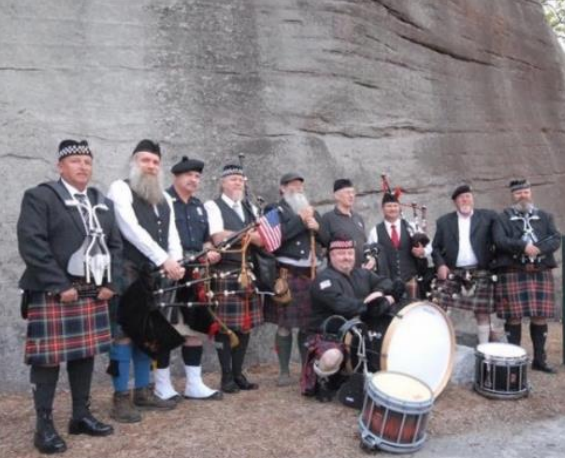
Clan Lindsay Pipe Band
When Jeff Coburn moved away from Durham, he missed playing with the McLeod Pipe Band, so formed the Deep River Pipe Band (2001) in the Archdale community. When that band dissolved, Bob Norris called on a few of its players to form the Triad Highlanders (2010) north of Greensboro while others were available to join Mark
Elliott’s new Clan Lindsay Pipe Band (2010) in the Clemmons area. Darrell Thompson, of the NCSU Pipes and Drums organized the Durham School of the Arts Pipe Band (2007) where he taught. When John Sprague retired as Director of the NCSU Pipes and Drums, he pulled together a few former band members to form a small performance band, Piobadh na Triantan (2014).
Piobadh na Triantan

Pick Up Bands

Chimney Rock Volunteer Pipe Band
Through the years, a few “pick up bands” have gathered annually to play for an event. The Grandfather Mountain Volunteer Pipe Band formed to play at the Grandfather Mountain Highland Games 1965 – 1966. Similarly, the Mint Hill Highlanders (2010) were the host band at the Mint Hill Highland Games near Charlotte. The Chimney Rock Volunteer Pipe Band (2015) plays at Easter Sunrise Services in Chimney Rock State Park. Piping schools, the School of Scottish Arts and the North American Academy of Piping and Drumming, have formed student bands to play for ceremonies during the Grandfather Mountain Highland Games.

Juvenile Pipe Bands

Pipe bands began in NC in 1946 with a youth band. The high school bands and scout bands are no longer active, but each left its impact on piping in NC as many of those same players continue to teach the next generation. A couple of newer bands began with a focus on younger players, but young people grow up, making youth bands challenging to maintain.

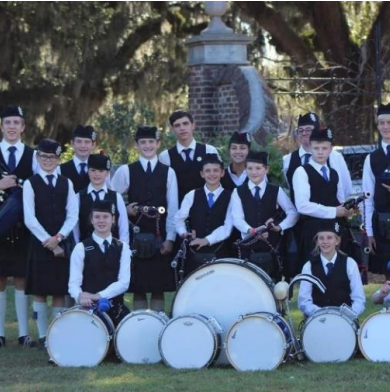
The Queen City Juvenile Pipe Band (2014) was begun by Andrea Jones, for youth 18 and under in the Charlotte area. They were successful on the competition circuit for several years. Andrea’s newest undertaking is the Rose and Thistle Ladies’ Pipe Band (2025), a branch of the Queen City Pipe Band. Female pipers and drummers worldwide are coming togetherto compete at the 2026 World Pipe Band Championship in Glasgow, Scotland.

Queen City Juvenile Pipe Band
Clan Lindsay Pipe Band

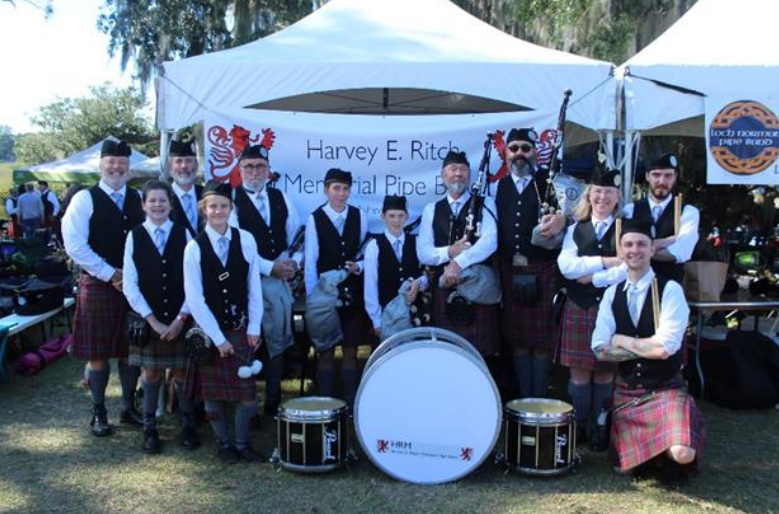
The Harvey E. Ritch Memorial Pipe Band (2019) was created by Gordon and Sally Warburton to continue Harvey Ritch’s lifelong goal of developing young pipers and drummers through quality instruction. The youth did well in competitions

Pipe bands in the state have usually been established by one individual passionate about piping, with both teaching and promotional skills. Bands enjoy their own traditions of performing for Burns Suppers, St. Patrick’s Day Parades, Easter sunrises, and festivals which North Carolina offers. At Highland Games, bands enjoy the awe of playing common tunes with a hundred pipers as one massed band

A Brief History of Piping in NC – Part III

A Brief History of Piping in NC – Part III

by Emily Sprague

Public Safety Pipe Bands, 2001 – 2026

Of all the bands organized in North Carolina in the second half of the twentieth century, none were considered “public safety” bands, none were associated with police or fire departments.  Having only civilian and student bands distinguished NC from Northern states where pipe bands have been part of fire and police departments since the 1800’s.  Then 9/11 happened.  For days, pipe bands paid tribute to comrades who perished saving others.  Within a few years, nine distinct pipe bands associated with police and fire departments were formed in NC towns and cities from the mountains to the coast.  Several other fire departments had smaller, less formal bands.

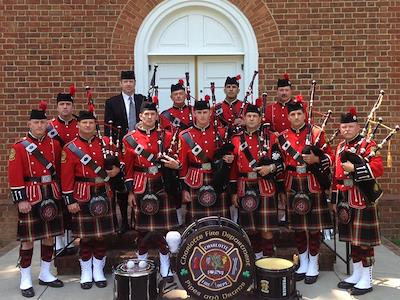
Charlotte Fire Department

Two bands formed in 2001, prior to 9/11. The first fire department pipe band in the state is the Charlotte Fire Department Pipes and Drums (Charlotte), beginning as part of the department’s Honor Guard with pipers David Thornburg and James Thompson.  

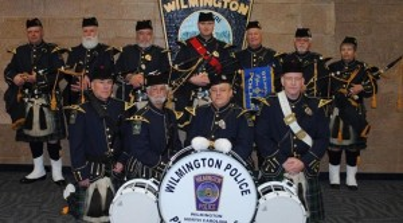
Through a dedicated instructional program, the band grew into a full complement of pipes and drums made up of all active duty fire personnel. The first police department pipe band is the Wilmington Police Pipes and Drums (Wilmington), started by officers Matt Hinson and Tom Tilmon.  All band members have a direct connection to the police department. 

Wilmington Police
Wake and District

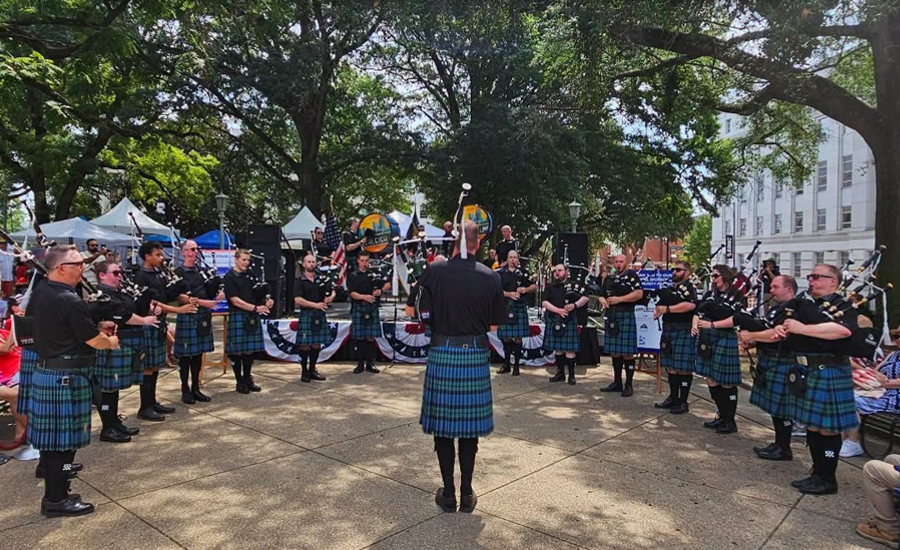
The next band to form was the Wake and District Public Safety Pipe Band (Raleigh) in 2006.  Although the mission of the band is to honor fallen public safety officers in NC, the band does not stipulate that players be active firefighters or police officers. Through the energy, imagination, and marketing skills of Joe Brady, the band grew into a strong competition band recruiting players from a wide geographic area.

Pipers were associated with fire departments along NC’s coast in Atlantic Beach, Morehead City, New Bern, and in Greenville.  Fire Chief Adam Snyder of the Atlantic Beach Fire Department pulled the individual bands together to form the Eastern Carolina Firefighters Pipes and Drums about 2006.  These pipers combined with other small groups associated with fire departments in Morrisville, Apex, and Cary to form the NC Brotherhood Pipes and Drums, bonding as one band to perform at the South Atlantic Fire and Rescue Expo in Raleigh in 2011.


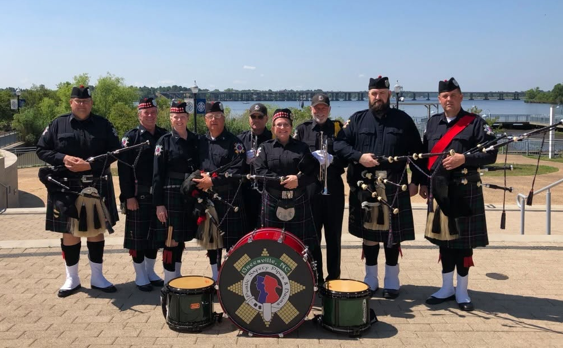
The Greenville Public Safety Pipes and Drums (Greenville) was formed in 2008 by Steve Hawley.  The motivation for the band’s formation came when a police officer was killed in the line of duty and the department had to recruit a piper from Charlotte to play at his memorial. The local fire and police departments decided it was time to form their own band.

Greenville Public Safety
Greensboro Fire Department

The Greensboro Fire Department Pipe Band (Greensboro) began in 2013 with Brad Shumate and Ian Trent playing at events in support of the Greensboro Fire Department, such as recruit graduations, award ceremonies, funerals, and other special events.  That band is inactive at present.

In 2010, the Asheville Fire Department proposed having a pipe band to provide brotherhood for firefighters.  Firefighter Patrick Boland was a serious piping student, becoming the Pipe Major of the Asheville Fire Department Pipe Band (Asheville), guiding it as it served the fire department for several years.

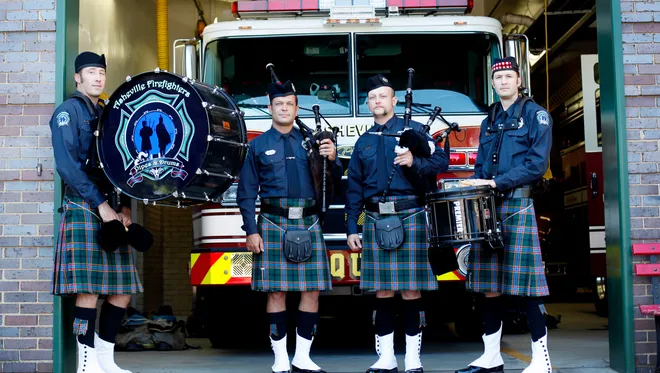
Asheville Firefighters
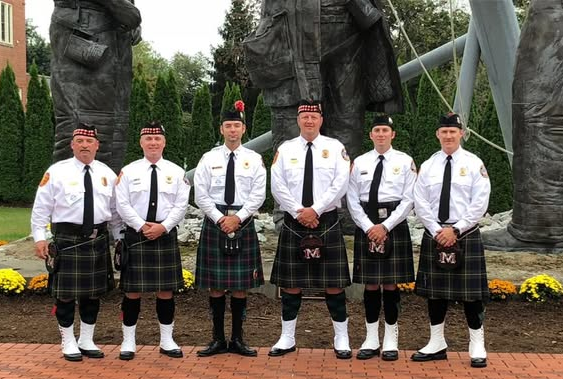
Mooresville Fire and Rescue

The Mooresville Fire – Rescue Pipes and Drums (Mooresville) was established in 2014 for the purpose of providing a ceremonial pipe band to perform at parades, funerals, memorials, dedications and graduations.  They maintain connections with other public safety pipe bands across the state and regularly attend SAFRE and Fallen Firefighter National Memorials in Emmitsburg, MD.

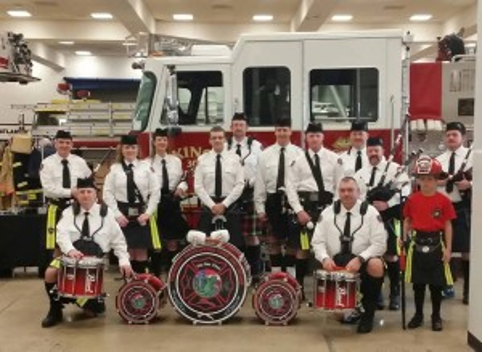
The Piedmont Fire Department Pipe Band (Lewisville) began in 2014 to serve firefighters and the community.  Fire Chief Scott Alderman of the Lewisville Fire Department was instrumental in bringing together interested people from fire departments and emergency services throughout the Triad area.  Jim Ritchey serves as the band’s Pipe Major.

Piedmont Firefighters
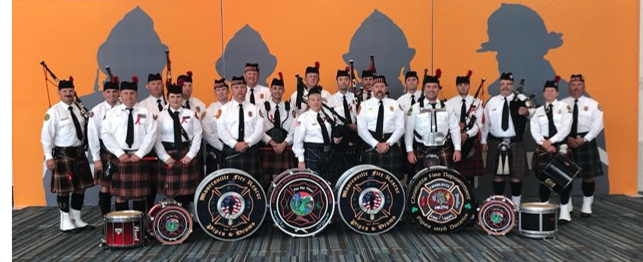
SAFRE Expo with Combined Bands

The Mooresville Fire – Rescue Pipes and Drums (Mooresville) was established in 2014 for the purpose of providing a ceremonial pipe band to perform at parades, funerals, memorials, dedications and graduations.  They maintain connections with other public safety pipe bands across the state and regularly attend SAFRE and Fallen Firefighter National Memorials in Emmitsburg, MD.

There are commonalities amongst all these North Carolina public safety pipe bands.  Often, a pipe band was the idea of someone high up in the organization.  It helps to get support from the chief.  Each band began by finding expert local instruction in piping and drumming.  Bands took pride in adopting or designing a meaningful tartan for kilts.  The list of performances always includes funerals, graduations, and 9/11 memorial events.  Officer bands also look sharp marching in St. Patrick’s Day and Christmas parades.  More experienced pipers and drummers freely give their time to assist newly formed bands in neighboring communities.

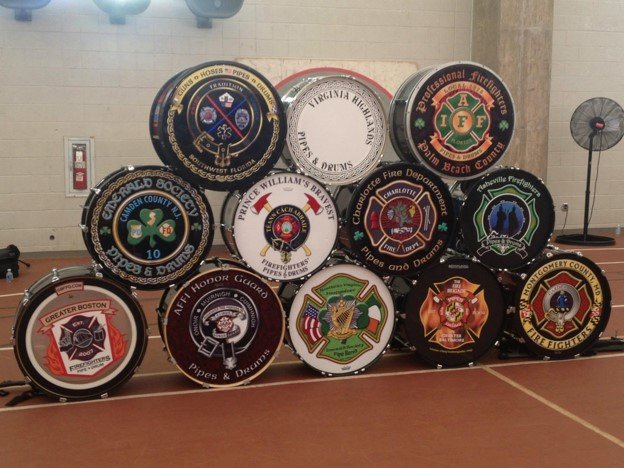
Most fire department bands say the SAFRE (South Atlantic Fire Rescue Expo) in North Carolina and the National Fallen Firefighter Memorial in Emmitsburg, MD are the highlight of the band’s year. Bands take pride in their dress and deportment, updating uniforms and creating unique cap badges and bass drum insignia.  When the bands are together, there is a palpable sense of brotherhood and shared common purpose as they honor their own who died while keeping others safe.  Showing respect while playing in a 300 member band is what brings the pipers and drummers back year after year.

Bass Drums at National Fallen Firefighters Memorial, Emmitsburg, MD